October 5, 2026 · Steve Johnson
OpenAPI Schema Drift Detection in CI Pipelines
A developer renames user_id to userId in a response payload. Three weeks pass, dozens of commits land, and then a mobile client built against the old field name starts crashing in production, so someone has to work backward through a release history to figure out which change did it. That sequence is the whole argument for this piece: an OpenAPI spec only works as a contract when something in the delivery pipeline is willing to stop and refuse to proceed the moment reality stops matching it. Without that refusal mechanism, the spec becomes a document people read occasionally but stop trusting more and more.
The drift that produces incidents like the userId rename comes from a structural flow, not from any one engineer cutting corners. Four copies of the same contract exist at once, and nothing forces any of them to agree with the other three. So drift isn't a bug that slips through now and then; it's what normal, well-intentioned work produces by default.
The concrete shapes drift takes are mundane and still damaging. An endpoint that the contract says returns 204 starts returning 404 instead. A mandatory authentication header gets dropped from a handler during a refactor, and nobody notices it, because nothing checks for it against the spec.
What makes each of these expensive is that none of them breaks anything visibly at the moment they happen. The failure only becomes visible when a consumer elsewhere, often on a different team or inside a different company altogether, hits the changed behavior in production, usually weeks after the change shipped and well after the original context has been buried under unrelated work.
Twelve out of 28 services drifting silently for the better part of a year shows what happens to any multi-service system when nothing in its pipeline is assigned to check the contract against the code.
The detection-cost asymmetry that makes pipeline placement a strategic decision
Drift being expensive is only half the argument. The cost of fixing a given mismatch rises sharply the longer it goes undetected, making where a check sits in the pipeline a real design decision. If you catch a schema mismatch in CI, while the developer who made the change still remembers why, it takes minutes to fix. The same mismatch caught in production weeks later turns into an investigation that takes hours by itself, before any fix gets written, because someone now has to reconstruct intent from code they didn't write and a change they weren't part of.
A B2B payments platform, with engineers numbering in the low hundreds and dozens of both internal microservices and partner-facing endpoints, shows what deferred detection looks like once it compounds at scale. None of these looked serious in isolation. Together, across six months, they produced multiple P1 incidents, and engineering leadership only mandated contract testing after the fourth outage made the pattern impossible to ignore.
The lesson from that case is that effective drift detection needs checks positioned at distinct stages of the pipeline, because each stage is built to catch a different class of failure and none of them covers for the others. A check that only runs at one point will always leave a gap that a different kind of drift walks straight through.
That requirement comes down to three artifacts that need to be compared against each other, not two: the contract as it currently exists on the target branch, the contract as proposed in a pending change, and the actual responses produced by the implementation once it's running.
Layer one: spec-to-spec diffing in pull requests
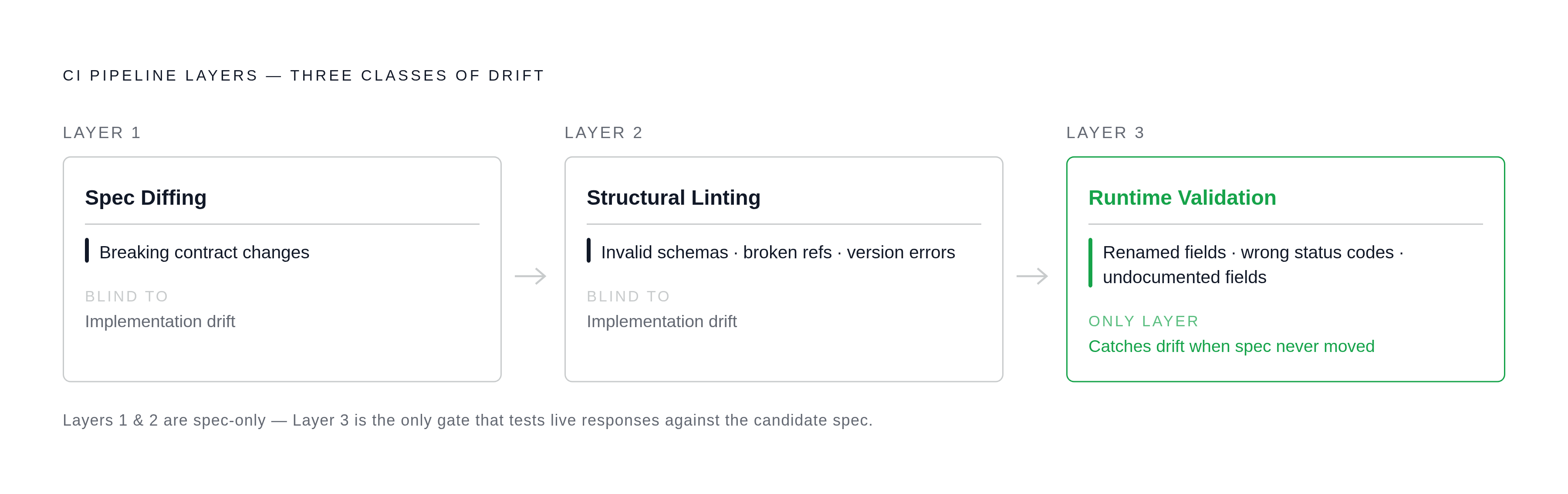
Spec-to-spec diffing belongs first in the sequence because it runs against artifacts that already sit in version control, it finishes in seconds, and it catches breaking changes the moment a developer opens a pull request, long before any of that code reaches a deployed environment. It compares the contract on the target branch against the contract proposed in the change, and it does that cheaply enough to run on every single pull request without slowing anyone down.
A diff between two version-controlled documents makes all of these visible.
What it cannot catch is the harder case: code that changed while the spec stayed untouched. If a developer modifies the implementation without touching the spec file, a spec-to-spec diff has nothing to compare, because from its point of view nothing changed. The implementation drifts silently, and this layer, by its very design, has no way to see it.
oasdiff is the practical standard for this job. If your team maintains OpenAPI specs and wants a first CI guardrail, this is a sensible place to start. PactFlow Drift, which SmartBear launched in March 2026, takes a different approach at this same layer: it uses AI to generate test suites straight from an OpenAPI spec and then runs those generated tests in CI to confirm the implementation still conforms. If your team already uses PactFlow's broader contract-testing tools, or the separately available PactFlow MCP Server to bring AI coding agents into the workflow, Drift is a strong complement, though pricing for it hadn't been published as of its release.
The base side of the comparison has to be a version-controlled artifact, not a live production URL fetched fresh at CI runtime, which keeps the comparison stable and reproducible across runs. Settling that question at the start of a project, before any drift has accumulated, is far cheaper than settling it after a partner integration breaks.
Layer two: structural linting of the OpenAPI document itself
A spec-to-spec diff tells you two documents are different from each other. It tells you nothing about whether either one is actually valid. Structural linting fills that gap: it checks a single OpenAPI document on its own terms, looking for missing required shapes, broken references, and schema objects that downstream tools won't agree on how to interpret.
This matters in practice because test generators, client SDK generators, and contract testing tools don't fail loudly when you hand them an invalid spec. They produce different output from the same bad document, quietly, and those disagreements don't throw errors anywhere. They just generate code that looks fine and fails later, somewhere downstream, in a way that's hard to trace back to the spec that caused it.
The industry is shifting toward OpenAPI 3.1 now, and that shift is producing exactly this kind of failure. A version bump that reads like a formality on paper can quietly break half a test suite, on fields that never changed in substance.
The clearest single example of this is the handling of nullable. A 3.0 spec using nullable: true that gets mechanically converted to 3.1 without being rewritten as type: ["string", "null"] produces a schema that is structurally invalid under the new spec version, something a proper linter will catch immediately. A naive spec-to-spec diff will not catch it, because both sides of that diff carry the same mistake and look identical to each other even though both are wrong.
The output of that linting step needs to gate the rest of the pipeline: a structural validation failure should block the spec-to-spec diff and the runtime checks from running at all, since running either of those against a malformed document produces results nobody should trust.
Layer three: runtime response validation against the candidate spec
SmartBear's own workflow for building PactFlow Drift illustrates why this third layer has to exist separately from the first two. Their system uses Claude to read an API definition and generate a test file covering the operations and scenarios that definition describes: happy paths, error codes, auth failures, and more. That approach works because it tests the running implementation against the spec, so it doesn't just test the spec against itself. Runtime validation is the only layer built to catch the case where a developer changed the code and left the spec alone, which is exactly the blind spot that spec-to-spec diffing can't see into, because the spec file itself never moved.
This layer catches what the first two structurally cannot: a response field quietly renamed inside the implementation, a field that used to always return a value now returning null under some condition nobody tested for, an endpoint returning 200 where the spec promises 201, or an undocumented field showing up in live responses and getting picked up by downstream code anyway. None of that is visible from comparing two documents or validating one document's internal structure. You only see it once real responses get exercised against the candidate contract.
The full workflow these three layers build toward runs in sequence on every change: lint the document, compare the base and candidate specifications inside the pull request, exercise representative responses against the candidate contract, and then publish the exact file that CI validated, with that published artifact matched against what CI checked by content digest. Skipping that last step, publishing documentation generated separately from what CI actually validated, recreates the four-copies problem that made drift possible.
A fair objection follows from this setup: runtime validation inside CI only exercises the candidate spec against a test environment at the moment the pull request runs. It has no way to see a service that drifts from its spec after it's already deployed, through dependency updates, configuration changes, or data model shifts that happen outside any pull request. That objection is correct, and it doesn't undercut the case for the three CI layers, it defines the boundary of what they're responsible for. The CI runtime check exists to catch drift before deployment. A separate, continuous layer is needed to catch drift after deployment, and neither one does the other's job.
Post-Deployment Drift and the Monitoring Layer
CI gates only run when something triggers them: a push, a pull request, a deploy. A service can be fully compliant with its spec at the moment of deployment and badly out of sync with it a month later, with CI having no occasion to notice, because CI simply isn't running anymore by that point.
Post-deployment drift monitoring works on a different axis. Instead of reacting to pipeline events, it makes real HTTP requests to live endpoints on a recurring schedule and checks what comes back against either a learned baseline or the OpenAPI spec itself, so it catches what CI cannot, because CI isn't running when the drift occurs.
A comparison of tools in this space, drawn from an April 2026 roundup, shows how differently vendors have approached the problem. FlareCanary polls live endpoints on a schedule, checks responses against a learned baseline or an OpenAPI spec, classifies drift by severity as breaking, warning, or informational, and extends that same monitoring to MCP server tool schemas. API Drift Alert focuses on severity-aware alert routing, including PagerDuty integration and filtering that holds back non-critical changes during off-hours, and it's priced from $149 a month for 12-hour checks up to $749 a month for 15-minute checks, with no free tier and only a 7-day trial. APIShift offers live monitoring with a four-level severity scale (low, medium, high, critical), priced free for five APIs on hourly checks, $29 a month for 5-minute checks, and $99 a month for unlimited endpoints checked in real time, a tier that holds up well against the cost of high-frequency checking elsewhere in this list. Rumbliq takes a broader approach, bundling drift detection alongside uptime, SSL, DNS, and cron monitoring in one general-purpose platform, priced free, then $12, $29, or $69 a month depending on tier, with drift detection implemented as a simpler JSON response diff without severity classification or multi-sample baselines, built to cover many things at once.
None of these tools are competing with the CI layers described earlier. They're solving a problem CI structurally cannot reach: behavior that changes after the pipeline has already finished running.
MCP tool schemas as a new drift surface with no standard enforcement layer yet
MCP servers expose tool schemas the same way REST APIs expose OpenAPI specs: as a contract that a consuming agent is expected to rely on. Those schemas can drift in the same practical sense that REST contracts drift, a tool's parameters change shape, a return type shifts, a field gets renamed, except that none of the three-layer CI model described above exists yet as standard practice for this surface. There is no equivalent of oasdiff that most teams run against MCP tool schemas on every pull request, no equivalent of Redocly CLI's structural linting built specifically for MCP's schema format, and no established runtime-validation step that checks an MCP server's actual tool behavior against its declared schema before merge.
FlareCanary's inclusion of MCP server tool schema tracking in its post-deployment monitoring stands out because it's an early entrant into a gap, not a mature standard. It applies the same severity classification it uses for REST drift, breaking, warning, informational, to changes in tool definitions exposed by MCP servers. On the REST side, three separate CI gates work together to address that before anything ever reaches a monitoring tool at all, but here you only get an answer at the monitoring layer.
The absence of equivalent CI-layer tooling for MCP doesn't mean the underlying risk is any smaller. Until a comparable set of diff, lint, and runtime-validation gates exists for MCP schemas the way it now exists for OpenAPI, teams building against MCP servers are operating with less protection against drift than teams building against REST APIs already have available to them.